

The words discreet and discrete look and sound similar, so it is easy to confuse them. However, they have completely different meanings and uses. Discreet describes someone or something that is careful, tactful, or private, while discrete means separate, distinct, or individually different. In this guide, you will learn the difference between discreet vs discrete, their meanings, pronunciation, examples, and simple ways to remember which word to use.
Quick Answer: Discreet Vs Discrete
Discreet means careful, tactful, private, or unobtrusive.
Discrete means separate, distinct, or individually identifiable.
Compare these examples:
Please be discreet about the salary discussion.
Here, discreet means careful and respectful of privacy.
The project has four discrete stages.
Here, discrete means separate and individually identifiable.
The simplest way to remember the difference is:
Discreet = careful or unobtrusive.
Discrete = separate or distinct.
Both words are correct. They simply do different jobs.
Why Are Discreet And Discrete Confused?
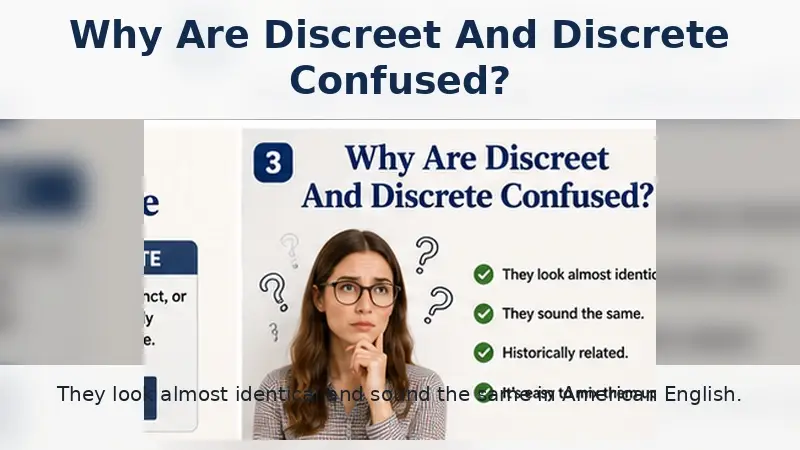
The words are easy to confuse for two main reasons: they look almost identical and are pronounced the same in common American English.
Both are generally pronounced dih-SKREET.
Because pronunciation does not help you distinguish them, you have to rely on spelling and meaning.
The words are also historically related, which helps explain their similar appearance. However, modern English uses them as separate words with different meanings.
A useful memory aid is:
- Discreet → think secret, privacy, or tact.
- Discrete → think separate.
The memory aid is helpful, but the meaning should always guide your choice.
Discreet Meaning And Usage
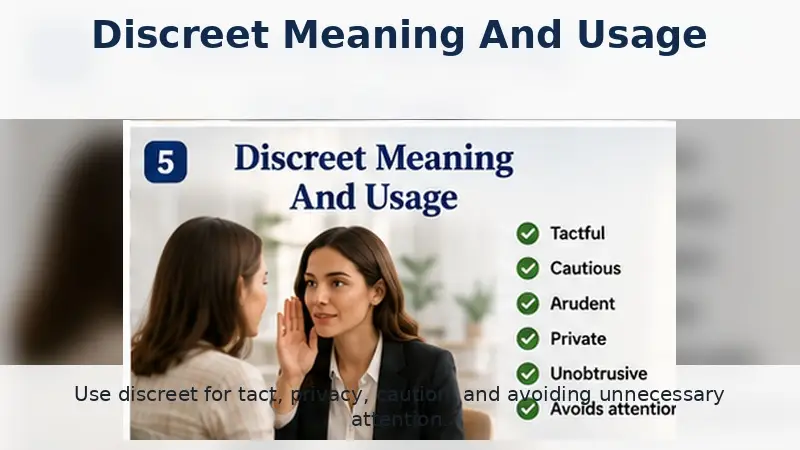
Discreet describes someone or something that avoids unnecessary attention or handles a situation with care and good judgment.
It can mean:
- tactful
- cautious
- prudent
- private
- unobtrusive
- not attracting unnecessary attention
For example:
The assistant was discreet when discussing the client’s complaint.
The assistant showed tact and avoided making the sensitive matter public.
The hotel offers discreet packaging.
The packaging is designed to avoid drawing attention.
She gave him a discreet signal to leave.
The signal was subtle and unobtrusive.
Importantly, discreet does not always mean “secret.” A person can be discreet simply by behaving tactfully or avoiding unnecessary attention.
Discrete Meaning And Usage
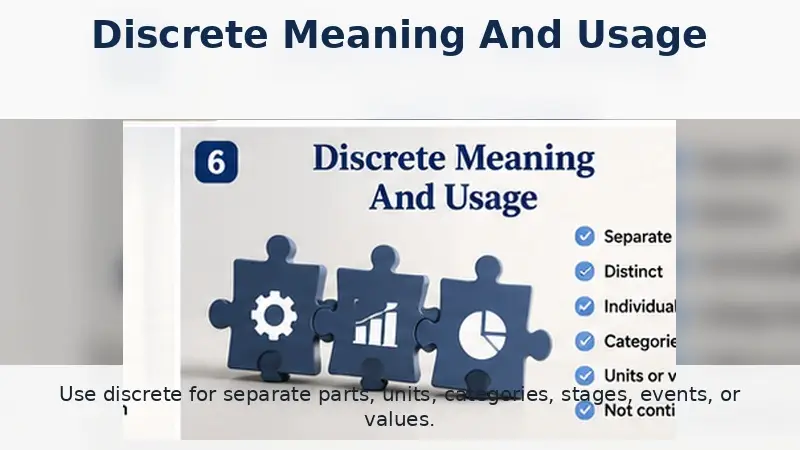
Discrete means separate, distinct, or individually identifiable.
Use it when you are talking about things that can be viewed as separate units, parts, categories, or events.
For example:
The training course is divided into six discrete modules.
Each module is a separate part of the course.
The survey placed respondents into several discrete categories.
The categories are distinct from one another.
The machine contains several discrete components.
The components are separate identifiable parts.
Discrete is also common in mathematics, science, statistics, and technology. In these fields, it often describes values or units that exist separately rather than along a continuous range.
For example:
The study analyzed discrete data.
The key idea is still the same: the values or units are separate and individually distinguishable.
Key Difference Between Discreet And Discrete
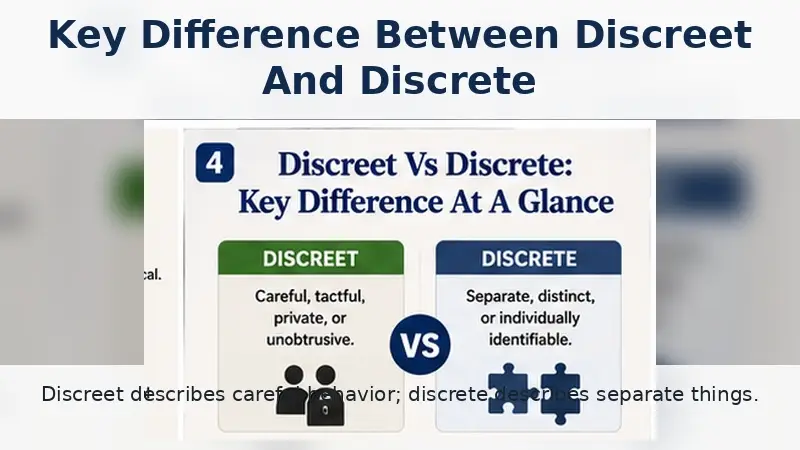
| Feature | Discreet | Discrete |
|---|---|---|
| Core meaning | Careful, tactful, private, or unobtrusive | Separate, distinct, or individual |
| Usually describes | Behavior, communication, actions, or things designed not to attract attention | Parts, units, categories, stages, events, or values |
| Main idea | Avoiding unwanted attention or handling something carefully | Existing separately from other things |
| Example | a discreet inquiry | discrete categories |
| Common adverb | discreetly | discretely |
The most important question is:
Am I describing how something is handled, or whether something is separate?
If you are describing careful or unobtrusive behavior, use discreet.
If you are describing separate units or distinct parts, use discrete.
Discreet Vs Discrete In Common Contexts
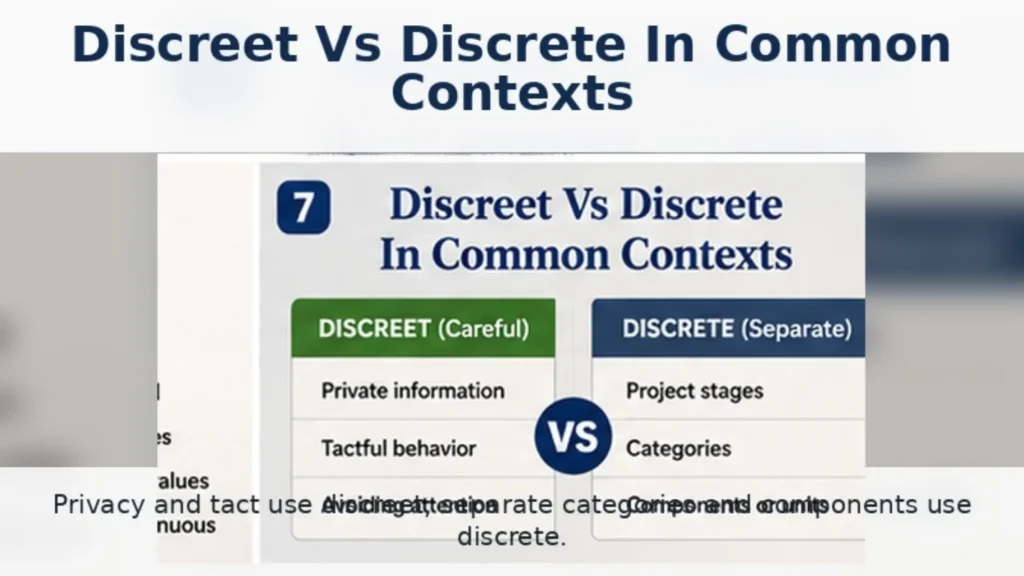
| Context | Best Choice | Example |
| Private information | Discreet | Please be discreet about the investigation. |
| Tactful behavior | Discreet | She was discreet when asking about the employee’s situation. |
| Avoiding attention | Discreet | The security team kept a discreet distance. |
| Separate project stages | Discrete | The plan has four discrete stages. |
| Separate categories | Discrete | The survey used five discrete categories. |
| Individual components | Discrete | The device contains several discrete components. |
| Separate values or units | Discrete | The analysis used discrete values. |
When To Use Discreet
Choose discreet when the sentence involves behavior, communication, privacy, tact, or avoiding attention.
Discreet About Private Information
The lawyer was discreet about the client’s situation.
The lawyer handled the information carefully.
Discreet Behavior
He was discreet when discussing the disagreement with his coworkers.
He avoided unnecessary attention and handled the situation tactfully.
Discreet Appearance Or Design
The store installed a discreet security camera.
The camera is designed to be unobtrusive.
Discreet Actions
She made a discreet exit before the meeting ended.
She left without attracting much attention.
When To Use Discrete
Choose discrete when the sentence involves separate parts, distinct categories, individual units, or noncontinuous values.
Discrete Parts
The device has three discrete components.
The components are separate parts.
Discrete Steps
The process consists of five discrete steps.
Each step is treated as a distinct stage.
Discrete Categories
The survey divided the responses into discrete groups.
The groups are separate categories.
Discrete Events
Each event was recorded as a discrete occurrence.
Each event was treated as a separate occurrence.
Discreet Vs Discrete In Similar Sentences
These examples show how the two words can create completely different meanings.
Discreet
The manager was discreet about the employee’s complaint.
The manager handled the sensitive information carefully.
Discrete
The report divided the complaint process into discrete stages.
The stages were separate parts of the process.
Another example:
She made a discreet inquiry about the job.
She asked carefully and tactfully.
The company offers several discrete job categories.
The categories are separate and distinct.
Common Mistakes With Discreet And Discrete
Mistake: Using Discrete For Privacy
Incorrect:
Please be discrete about the announcement.
Correct:
Please be discreet about the announcement.
The sentence is about keeping information private and handling it carefully.
Mistake: Using Discreet For Separate Parts
Incorrect:
The report contains four discreet sections.
Correct:
The report contains four discrete sections.
The sections are separate parts of the report.
Mistake: Assuming Discreet Means Only Secret
Discreet can involve privacy, but it can also mean tactful, cautious, prudent, or unobtrusive.
For example:
The reporter asked a discreet question.
The question may not be secret. It is simply asked with tact and care.
Mistake: Assuming Discrete Means Only Technical
Discrete is common in technical writing, but you can also use it in ordinary contexts.
The book is divided into three discrete sections.
No technical subject is required. The sections are simply separate and distinct.
Discreetly Vs Discretely
The adverbs follow the same basic distinction.
Discreetly means in a careful, tactful, private, or unobtrusive way.
She discreetly asked whether the meeting had been canceled.
Discretely means as separate or distinct units.
The data points were analyzed discretely.
Discretely is less common in everyday conversation, but it can be appropriate when the meaning involves separate units or individual treatment.
Do not confuse discreetly with discretely simply because they sound the same.
Discreet And Discrete In Everyday American English
Here are natural examples of discreet:
- Please be discreet about the personnel changes.
- She made a discreet inquiry about the apartment.
- The doctor was discreet when discussing the patient’s condition.
- The company provides discreet delivery.
- He gave me a discreet nod from across the room.
Here are natural examples of discrete:
- The course is divided into discrete lessons.
- The system has several discrete parts.
- The report identifies three discrete causes.
- The study compared four discrete groups.
- The process follows a series of discrete steps.
Which One Should You Use?
Use this quick decision test:
Does the sentence involve tact, privacy, caution, or avoiding attention?
Choose discreet.
She was discreet about the conversation.
Does the sentence involve separate parts, categories, units, or values?
Choose discrete.
The project has several discrete phases.
If you are still unsure, try replacing the word:
- careful, tactful, or unobtrusive → discreet
- separate, distinct, or individual → discrete
Dictionary-Style Word Details
Verb
- Discreet: Not commonly used as a verb in standard American English.
- Discrete: Not commonly used as a verb in standard American English.
Both words are primarily adjectives.
Noun
- Discreet: Related nouns include discretion, meaning good judgment or careful conduct, and discreetness, meaning the quality of being discreet.
- Discrete: The related noun discreteness refers to the quality of being separate or distinct.
These related forms reflect different meanings and should not be treated as interchangeable.
Synonyms
Discreet, closest plain alternatives include:
- tactful
- cautious
- prudent
- subtle
- unobtrusive
- circumspect
The best alternative depends on the sentence.
Discrete, closest plain alternatives include:
- separate
- distinct
- individual
- detached
- independent
Again, these are not perfect replacements in every context.
Example Sentences
Discreet:
The assistant was discreet when handling the confidential documents.
She made a discreet inquiry about the position.
The security team maintained a discreet presence.
Discrete:
The program has four discrete stages.
The researcher studied several discrete groups.
The machine contains multiple discrete components.
Word History
Discreet and discrete are historically related and trace back to the same Latin source. Over time, English developed the two modern forms with different meanings and spellings.
Today, their shared history does not make them interchangeable.
In modern usage, discreet is associated with careful, tactful, or unobtrusive behavior, while discrete refers to things that are separate or distinct.
Phrases Containing
Common phrases with discreet include:
- be discreet
- discreet conversation
- discreet inquiry
- discreet distance
- discreet location
- discreet packaging
- discreet manner
Common phrases with discrete include:
- discrete units
- discrete stages
- discrete categories
- discrete components
- discrete events
- discrete values
- discrete data
Frequently Asked Questions
Is discreet or discrete correct for private information?
Discreet is correct when you mean careful, tactful, or respectful of privacy.
Please be discreet about the information.
Is discreet or discrete correct for separate parts?
Discrete is correct when you mean separate or distinct.
The machine has several discrete parts.
Are discreet and discrete pronounced the same?
Yes. In common American English, both are generally pronounced dih-SKREET.
Is discrete the same as separate?
Often, yes, depending on the context. Discrete commonly means separate, distinct, or individually identifiable.
Does discreet mean secret?
Not exactly. Discreet can involve privacy, but it more broadly means careful, tactful, prudent, or unobtrusive.
What is an easy way to remember discreet vs discrete?
Think of discreet as connected with being careful about a secret. Think of discrete as meaning separate or distinct.
Conclusion
Use discreet when you mean careful, tactful, private, prudent, or unobtrusive.
Use discrete when you mean separate, distinct, or individually identifiable.
Discrete = separate and distinct.
Discreet = careful and unobtrusive.
They sound the same, but they do not mean the same thing. When you focus on whether the sentence describes careful behavior or separate units, choosing the correct word becomes much easier.