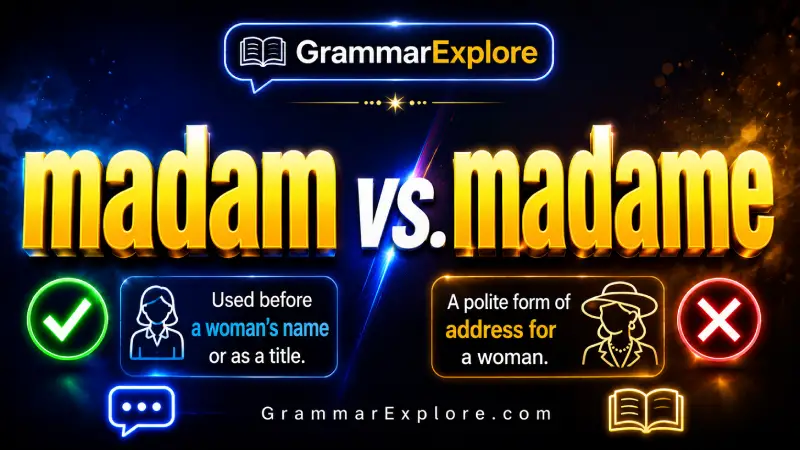
Madam vs Madame is more than a spelling choice. The words share a historical connection, but modern English uses them in different contexts.
Madam is an English form of respectful address for a woman. It commonly appears by itself, in a formal letter, or before an official position:
May I help you, madam?
Madam President addressed the audience.
Madame, in contrast, is the French title corresponding roughly to Mrs. or Ms. English writers usually keep it when referring to a French-speaking woman or someone known by that title:
Madame Curie conducted groundbreaking research.
The pronunciations also differ. Madam sounds like “MAD-um,” while Madame usually sounds like “muh-DAHM.”
Therefore, use madam for formal English address and Madame for the French title.
Quick Answer
Both words are correct, but they are not normally interchangeable.
- Madam is a formal English term used to address a woman.
- Madame is a French title used before a woman’s name or as a French form of address.
- Ma’am is the contraction of madam.
- Use Madam President, not Madame President, in English.
- Use Madame Curie, not Madam Curie, when preserving the French title.
The simplest rule is:
English address → madam
French title → Madame
Is It Madam or Madame President?
Both are correct, but they are used in different contexts. Madam is the standard English form of respectful address, while Madame is the French spelling and is used in official titles such as Madame President in some countries and organizations. Follow the official style or title being used.
Can I Call My Wife Madam?
Yes, you can, but it is uncommon in everyday English. Madam is a formal and respectful form of address, often used for customers, officials, or women in positions of authority. Most people use terms such as dear, honey, or their spouse’s name in daily conversation.
Do British People Say “Madam”?
Yes. Madam is used in British English as a polite and formal way to address a woman, especially in customer service, schools, official settings, and formal conversations. It is less common in casual, everyday speech.
Why People Confuse Them
The words look similar because they share the same historical root. In fact, madam developed from the French expression connected with madame, meaning “my lady.”
However, English pronunciation and usage changed over time. As a result, madam became the established English form, while Madame remained associated with French language and culture.
Names and official titles create further confusion.
In English, you may hear:
- Madam President
- Madam Chair
- Madam Secretary
- Dear Madam
However, famous French names may include:
- Madame Curie
- Madame Bovary
- Madame de Staël
Another source of confusion is ma’am. Some writers mistakenly treat it as a contraction of Madame. However, ma’am is the shortened English form of madam.
Key Differences At A Glance
| Context | Best Choice | Why |
|---|---|---|
| Polite English address | Madam | Standard formal English term |
| Before an official position | Madam | Used in titles such as Madam President |
| Formal letter to an unknown woman | Madam | Conventional salutation |
| French title before a surname | Madame | Preserves French usage |
| Addressing a French-speaking woman in French | Madame | Standard French title |
| Everyday polite US address | Ma’am | More natural contraction of madam |
| Famous French name or character | Madame | Part of the established name |
| Woman who manages a brothel | Madam | Separate dictionary meaning |
| Context | Best Choice | Why |
|---|---|---|
| Polite English address | Madam | Standard formal English term |
| Before an official position | Madam | Used in titles such as Madam President |
| Formal letter to an unknown woman | Madam | Conventional salutation |
| French title before a surname | Madame | Preserves French usage |
| Addressing a French-speaking woman in French | Madame | Standard French title |
| Everyday polite US address | Ma’am | More natural contraction of madam |
| Famous French name or character | Madame | Part of the established name |
| Woman who manages a brothel | Madam | Separate dictionary meaning |
A compact comparison makes the distinction clear:
- Madam: English form of address
- Madame: French title
- Ma’am: Contraction of madam
- Pronunciation: Different
- Parts of speech: Both are nouns or titles
- Interchangeable: Usually no
Meaning And Usage Difference
What Does Madam Mean?
Madam is a formal and respectful English term used when addressing a woman.
For example:
- May I take your coat, madam?
- This way, madam.
- Excuse me, madam, but you dropped your wallet.
- Would you like another cup of coffee, madam?
Cambridge defines madam as a formal, polite way of speaking to a woman. It also records its use before the title of a senior position. Cambridge Dictionary
In everyday American conversation, ma’am usually sounds more natural:
Can I help you, ma’am?
The full word madam may sound very formal, ceremonial, old-fashioned, or service-oriented in ordinary US speech.
Madam Before An Official Position
Capitalize Madam when it forms part of a formal title or direct address before an office.
For example:
- Madam President
- Madam Speaker
- Madam Secretary
- Madam Chair
- Madam Ambassador
In a sentence:
Madam President, the committee is ready.
Thank you, Madam Chair, for recognizing me.
Here, Madam identifies the woman by her official position. Therefore, replacing it with Madame would normally be incorrect in English.
Madam In Formal Letters
Dear Madam is a traditional salutation for a formal letter when the recipient is a woman but her name is unknown.
For example:
Dear Madam:
I am writing to request additional information.
However, modern business writing often favors a specific name, department, or role when available:
- Dear Ms. Rivera:
- Dear Hiring Manager:
- Dear Customer Service Team:
- Dear Admissions Officer:
These options usually sound more personal and precise. Still, Dear Madam remains grammatically correct.
What Does Madame Mean?
Madame is a French title of respect for a woman. In English writing, it often appears before the surname of a French or French-speaking woman.
For example:
- Madame Curie
- Madame Dupont
- Madame Lefèvre
- Madame de Staël
Merriam-Webster describes Madame as a title equivalent to Mrs. for a married woman who is not of English-speaking nationality. Modern French usage can be broader, but the key point for English writers is that Madame preserves a French title rather than serving as the usual English form of address. Merriam-Webster
For example:
We studied the life of Madame Curie.
Writing Madam Curie would remove the familiar French title.
Madame Without A Name
In a French-speaking context, Madame can stand alone as a polite form of address:
Bonjour, Madame.
However, English speakers normally use madam or ma’am when speaking English:
Good afternoon, ma’am.
Therefore, the language of the conversation determines the natural choice.
Madam As A Brothel Manager
Madam also has a separate noun meaning: a woman who manages a brothel. Both Merriam-Webster and Cambridge record this sense.
For example:
The novel portrays a powerful madam who controls the establishment.
This meaning depends entirely on context. It should not be confused with the respectful direct-address use.
Because the word has this additional sense, careless wording may occasionally create an unintended meaning. However, phrases such as Madam President and Dear Madam remain clear because their contexts establish respectful address.
Pronunciation Difference
The pronunciations provide a clear distinction.
How To Pronounce Madam
Madam is pronounced:
MAD-um
The stress falls on the first syllable.
It rhymes approximately with Adam in many American pronunciations.
How To Pronounce Madame
Madame is commonly pronounced in English as:
muh-DAHM
The stress usually falls on the second syllable.
When it appears before a surname, some English speakers may use a pronunciation closer to MAD-um. However, the French-influenced “muh-DAHM” pronunciation clearly distinguishes it from madam.
How To Pronounce Ma’am
Ma’am is pronounced:
mam
In some US accents, it may sound close to mahm or contain a slightly extended vowel.
Most importantly, ma’am is one syllable, while madam has two.
Tone, Context, And Formality
Madam sounds formal in American English.
It fits naturally in:
- Ceremonial speech
- Official proceedings
- Government titles
- Formal customer service
- Traditional letters
- Historical dialogue
For example:
Madam Speaker, I request permission to respond.
In everyday US conversation, however, ma’am is usually more natural:
Yes, ma’am.
Excuse me, ma’am.
The tone of ma’am varies by region. In parts of the United States, especially the South, speakers use it regularly as a polite form of address. Elsewhere, it may sound more formal or age-related. Therefore, context and local custom matter.
Madame carries a French or continental European tone in English writing. It may also appear in historical fiction, restaurant names, artistic titles, or established cultural references.
Avoid using Madame merely to make ordinary English sound more elegant. Unless the context is French or the title is established, madam or ma’am will usually fit better.
Which One Should You Use?
Use madam when formally addressing a woman in English.
For example:
May I assist you, madam?
- Use Madam before a formal position:
Madam President
Madam Chair
Use ma’am in everyday polite American speech:
Would you like a receipt, ma’am?
- Use Madame when preserving a French title:
Madame Curie
Madame Bovary
- Use Madame when speaking or writing in French:
Merci, Madame.
A practical rule is:
If you could naturally use sir for a man in the same English situation, use madam or ma’am for a woman.
If the title corresponds to French Monsieur, use Madame.
When One Choice Sounds Wrong
Consider this English political title:
Madame President addressed the nation.
In standard English, the conventional form is:
Madam President addressed the nation.
Now consider the French scientist Marie Curie:
Madam Curie won international recognition.
The established title is:
Madame Curie won international recognition.
Another mistake occurs when writers use Madame as an ordinary English customer-service address:
Can I help you, Madame?
If the conversation takes place in English, this will usually sound theatrical or French-influenced. A natural American version is:
Can I help you, ma’am?
The reverse applies in French:
Bonjour, Madame.
Here, Madame is appropriate.
Madam vs Ma’am
Ma’am is a contraction of madam.
Compare:
Formal:
Yes, madam.
More natural in everyday US speech:
Yes, ma’am.
The apostrophe in ma’am marks omitted letters. Do not write:
- mam
- maam
- ma’amn
The standard form is ma’am.
Common Mistakes (And Quick Fixes)
Mistake: Madame President spoke first.
Fix: Madam President spoke first.
Mistake: Madam Curie was a pioneering scientist.
Fix: Madame Curie was a pioneering scientist.
Mistake: Yes, maam.
Fix: Yes, ma’am.
Mistake: Dear Madame, I am applying for the position.
General English fix: Dear Madam, I am applying for the position.
Mistake: Assuming Madame is a more formal spelling of madam.
Fix: Recognize Madame as a French title, not merely an elegant English variant.
Mistake: Using madame for every woman with a French surname.
Fix: Use the title only when the person, context, or source uses it.
Mistake: Writing madame president in lowercase.
Fix: Use Madam President when directly addressing the officeholder.
Everyday Examples
Examples With Madam
May I help you, madam?
Your table is ready, madam.
This way, madam.
I apologize for the delay, madam.
Madam President will speak next.
Thank you, Madam Chair.
Dear Madam, I am writing about my application.
The witness addressed the chair as Madam Chair.
Examples With Ma’am
Yes, ma’am, I understand.
Excuse me, ma’am, you dropped your keys.
Would you like a bag, ma’am?
Thank you, ma’am.
No, ma’am, I have not seen it.
How can I help you, ma’am?
Examples With Madame
- Madame Curie became internationally famous.
- We read Madame Bovary in literature class.
- The host greeted Madame Dupont.
- Bonjour, Madame.
- The letter was addressed to Madame Lefèvre.
- They discussed the work of Madame de Staël.
Both Words In One Example
Madame Dupont entered the hotel, and the clerk asked, “May I help you, madam?”
The first word preserves a French title before a surname. Meanwhile, the second functions as an English form of direct address.
Dictionary-Style Word Details
Verb
Madam: Not commonly used as a verb in standard modern English.
Madame: Not commonly used as a verb.
Both terms function primarily as nouns, honorifics, or forms of address.
Noun
Madam: A formal English term used to address a woman. It can also precede a position or describe a woman who runs a brothel.
May I help you, madam?
Madam President entered the room.
Madame: A French title used for a woman, often before her surname.
Madame Laurent welcomed the guests.
Synonyms
Possible alternatives to madam depend on context:
- ma’am
- lady
- Ms.
- Mrs.
However, these terms are not interchangeable in every sentence.
For example, Ms. normally requires a surname:
Ms. Garcia
You would not usually say:
May I help you, Ms.?
For Madame, the closest English title may be:
- Mrs.
- Ms.
Still, the cultural and language context differs.
No useful antonyms apply. The traditional masculine counterparts are sir for madam and Monsieur for Madame, but these are corresponding titles rather than direct antonyms.
Example Sentences
Madam:
- Please follow me, madam.
- Madam Secretary answered the question.
- The letter began with “Dear Madam.”
- Yes, madam, your appointment is confirmed.
- The novel’s central character became a wealthy madam.
Madame:
- Madame Curie worked with radioactive materials.
- We discussed Madame Bovary.
- The invitation included Madame Bernard.
- Bonjour, Madame.
- The guide introduced us to Madame Moreau.
Word History
Madam and Madame share a historical connection. Both ultimately come from a French expression meaning “my lady.”
English adopted madam and developed its own pronunciation and uses. Meanwhile, Madame remained the standard French title and continued to appear in English when writers preserved a French name or context.
Therefore, the words are related, but modern usage separates them by language and situation.
Phrases Containing
Common expressions with madam include:
Dear Madam
- Madam President
- Madam Speaker
- Madam Secretary
- Madam Chair
yes, madam
no, madam
excuse me, madam
right this way, madam
Common expressions with Madame include:
- Madame Curie
- Madame Bovary
- Madame de Staël
- Bonjour, Madame
- Merci, Madame
Common expressions with ma’am include:
- yes, ma’am
- no, ma’am
- excuse me, ma’am
- thank you, ma’am
- may I help you, ma’am?
Frequently Asked Questions
What is the difference between madam and Madame?
Madam is an English form of respectful address. Madame is a French title used alone in French or before a woman’s surname.
Is it Madam President or Madame President?
In English, write Madam President.
Is it Madam Curie or Madame Curie?
Write Madame Curie because the phrase preserves the French title.
Is ma’am short for madam or Madame?
Ma’am is the contracted English form of madam.
Is Dear Madam correct?
Yes. Dear Madam is a traditional formal salutation when a woman’s name is unknown. However, a specific name or role often sounds more personal.
Can I call any woman Madame?
Not usually in English. Use Madame when speaking French, preserving an established French title, or following someone’s official style.
Should Madam be capitalized?
Capitalize it in a formal title or salutation, such as Madam President or Dear Madam. Lowercase it in general direct address unless your style requires otherwise: “May I help you, madam?”
Conclusion
The madam vs Madame distinction depends mainly on language and context.
Use madam as a formal English term of address:
May I help you, madam?
Use Madam before an official position:
Madam President
Use Madame as a French title or as part of an established French name:
Madame Curie
In everyday American speech, ma’am is usually more natural than the full word madam.
Remember:
English address → madam or ma’am
English office → Madam President
French title → Madame Curie
Although the words share a historical origin, they are not normally interchangeable in modern English.