
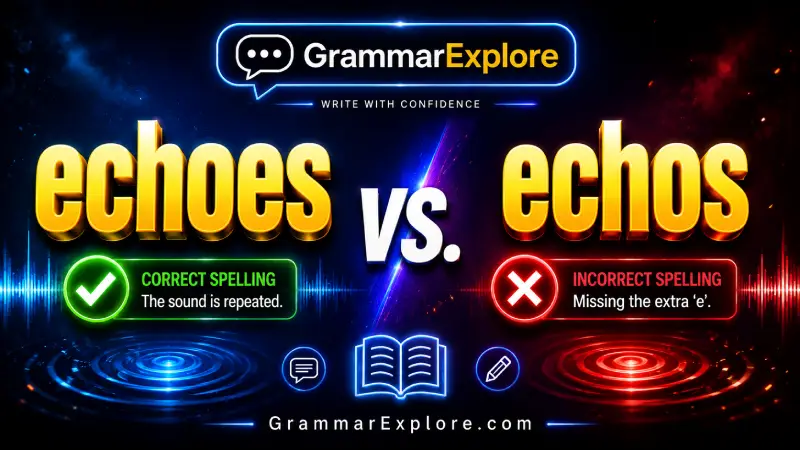
Echoes vs echos has a more nuanced answer than many spelling guides suggest. Echoes is the standard and strongly preferred spelling for the plural of echo. It is also the correct third-person singular form of the verb echo.
For example:
Our voices produced several echoes in the cave.
Her speech echoes the same concerns.
However, echos is not completely invented. Merriam-Webster records it as an alternative plural form of the noun echo. Still, many major dictionaries list only echoes, and the shorter form may look like a spelling mistake to readers.
Therefore, use echoes in general, academic, professional, and creative writing. Reserve echos for a context that specifically follows a dictionary or house style accepting that alternate noun plural. Never use echos as the third-person singular verb.
Quick Answer
Use echoes in almost every situation.
- Echoes is the preferred plural of the noun echo.
- Echoes is the correct verb form used with he, she, it, or another singular subject.
- Echos is a recognized but uncommon alternative noun plural in some dictionaries.
- Echos does not work as the standard verb form.
For clear modern US English, choose echoes.
Is It Echoes or Echos?
Echoes is the correct spelling. It is the plural form of echo and also the third-person singular form of the verb, as in Her voice echoes through the valley. Echos is a misspelling and should be avoided.
Is “Echos” or “Echoes” a Verb?
Echoes is the correct verb form when the subject is singular. For example, The sound echoes across the lake. Echos is not a standard English spelling and is considered incorrect.
Why People Confuse Them
Most nouns simply add -s to form the plural:
- book → books
- sound → sounds
- wall → walls
Therefore, some writers expect:
echo → echos
However, many nouns ending in -o take -es:
- hero → heroes
- potato → potatoes
- tomato → tomatoes
- echo → echoes
English does not apply one perfect rule to every word ending in o. For example, photo becomes photos, while hero becomes heroes. Consequently, writers often need to learn the conventional plural of each word.
Another source of confusion is that Merriam-Webster recognizes echos as an alternate noun plural. Merriam-Webster
Nevertheless, Cambridge and other major learner dictionaries give echoes as the plural. Cambridge Dictionary
This means echos has dictionary support, but echoes remains the safest and most familiar choice.
Key Differences At A Glance
| Context | Best Choice | Why |
|---|---|---|
| More than one repeated sound | Echoes | Standard and preferred noun plural |
| Similarities to an earlier idea or style | Echoes | Standard figurative plural |
| He, she, or it repeats a sound | Echoes | Correct third-person singular verb |
| A statement repeats another idea | Echoes | Correct verb form |
| Formal or academic writing | Echoes | Most widely recognized spelling |
| General American English | Echoes | Least likely to distract readers |
| Alternative noun plural | Echos | Recorded by some dictionaries but uncommon |
| Third-person singular verb | Never echos | Standard verb spelling requires -es |
A compact comparison makes the distinction clear:
- Echoes as a noun: Preferred plural of echo
- Echoes as a verb: He, she, or it repeats or reflects something
- Echos as a noun: Accepted by some dictionaries but uncommon
- Echos as a verb: Avoid
- Best general choice: Echoes
Meaning And Usage Difference
The meaning depends partly on whether echoes functions as a noun or a verb.
Echoes As A Plural Noun
An echo is a sound heard again after sound waves reflect from a surface. The preferred plural is echoes.
For example:
- Our footsteps created echoes in the empty hallway.
- The canyon returned several loud echoes.
- We heard echoes of their voices.
- The room’s hard walls produced noticeable echoes.
In these sentences, echoes names multiple repeated or reflected sounds.
Echoes As A Figurative Noun
Echoes can also mean similarities, reminders, traces, or lasting effects.
For example:
- The novel contains echoes of ancient mythology.
- Her design has echoes of the 1970s.
- The decision created political echoes across the country.
- His latest song carries echoes of his earlier work.
Here, no physical sound needs to repeat. Instead, something reminds people of an earlier idea, style, event, or experience.
Echoes As A Verb
Echoes is also the third-person singular present-tense form of echo.
Use it with a singular subject such as he, she, it, the sound, or the statement.
For example:
- Her voice echoes through the hallway.
- The music echoes across the lake.
- His argument echoes an earlier proposal.
- This design echoes the building’s original style.
- The empty room echoes whenever someone speaks.
In these examples, echos would be incorrect as the verb form.
What Does Echos Mean?
Echos can serve as an alternate plural spelling of the noun echo. Merriam-Webster lists the noun plural as “echoes also echos.”
For example, under that dictionary treatment, this sentence is possible:
The radar detected several echos.
However, most readers expect:
The radar detected several echoes.
Therefore, dictionary recognition does not make the forms equally common or equally advisable. Echoes remains the better choice for a broad audience.
Pronunciation
Both noun spellings would have the same pronunciation:
- Echoes: “EK-ohz”
- Echos: “EK-ohz”
The verb echoes also has the same pronunciation.
Therefore, pronunciation cannot help you choose the spelling. You must look at grammar and conventional usage.
Tone, Context, And Formality
Echoes works naturally at every level of formality.
You can use it in:
- Everyday conversation
- School assignments
- Scientific explanations
- Technical writing
- News reports
- Literature
- Music criticism
- Historical discussion
- Professional communication
For example:
The microphone created unwanted echoes during the presentation.
The proposal echoes recommendations from the earlier report.
Echos, meanwhile, may surprise readers even when a dictionary accepts it as a noun plural. Many people will assume the writer forgot the letter e.
Therefore, using echos can distract attention from your message. Unless a technical publication or established house style specifically requires it, choose echoes.
The difference is not about formality alone. Instead, it involves reader expectations and standard spelling preference.
Which One Should You Use?
Use echoes as your default in American English.
Choose echoes when you mean:
- Multiple reflected sounds
- Multiple repetitions
- Reminders of something earlier
- Similar artistic or cultural details
- Continuing effects
- A singular subject repeats or reflects something
For example:
The cave was filled with echoes.
Her opinion echoes what many residents have said.
Although some dictionaries accept echos as a plural noun, you rarely gain anything by choosing it. In contrast, you may make readers question the spelling.
Most importantly, use echoes whenever the word functions as a verb:
Correct:
His statement echoes the mayor’s concerns.
Incorrect in standard writing:
His statement echos the mayor’s concerns.
A reliable rule is:
When in doubt, always choose echoes.
When One Choice Sounds Wrong
Consider this sentence:
Strange echos came from the tunnel.
The spelling has limited dictionary support as a noun plural. However, most readers will expect:
Strange echoes came from the tunnel.
Now consider a verb:
The final scene echos the opening scene.
Here, echos is not the standard third-person singular verb form. Write:
The final scene echoes the opening scene.
The same rule applies to physical sound:
Incorrect:
Her voice echos through the building.
Correct:
Her voice echoes through the building.
Therefore, the alternative form echos applies only to the noun plural in dictionaries that recognize it. It does not replace echoes in every grammatical role.
Echoes, Echoed, And Echoing
The main forms of the verb are:
- Base form: echo
- Third-person singular: echoes
- Past tense: echoed
- Past participle: echoed
- Present participle: echoing
For example:
- Their voices echo through the room.
- Her voice echoes through the room.
- The sound echoed for several seconds.
- Laughter was echoing in the hallway.
Notice that echoing does not keep a second e before -ing. Write echoing, not echoeing.
Common Mistakes (And Quick Fixes)
Mistake: We heard echos in the cave.
Preferred fix: We heard echoes in the cave.
Mistake: Her voice echos through the room.
Fix: Her voice echoes through the room.
Mistake: The story echos an older legend.
Fix: The story echoes an older legend.
Mistake: The building was full of echo’s.
Fix: The building was full of echoes.
Mistake: His words echo’s my concerns.
Fix: His words echo my concerns.
Mistake: Her words echo’s my concerns.
Fix: Her words echo my concerns.
Mistake: The sound was echoeing through the tunnel.
Fix: The sound was echoing through the tunnel.
Mistake: Claiming that echos has never been accepted anywhere.
Fix: Explain that some dictionaries recognize it as an alternate noun plural, although echoes remains preferred.
Do Not Use An Apostrophe For The Plural
The plural of echo does not need an apostrophe.
Incorrect:
We heard several echo’s.
Correct:
We heard several echoes.
Use an apostrophe only when showing possession:
The echo’s volume gradually faded.
Here, the volume belongs to one echo.
For plural possession:
The echoes’ timing confused the listeners.
Everyday Examples
Echoes As A Plural Noun
We heard several echoes inside the cave.
Their laughter created echoes in the hallway.
The mountains returned the echoes of our voices.
Strange echoes came from the empty building.
Thick curtains can reduce echoes in a room.
The microphone produced unwanted echoes.
The canyon was full of echoes.
Bats use returning echoes to detect objects.
Echoes As A Figurative Noun
The speech contained echoes of earlier campaigns.
Her music has echoes of classic soul.
The novel includes echoes of Greek mythology.
The design carries echoes of the 1960s.
His latest work has clear echoes of his first book.
The conflict still has echoes in modern politics.
The painting contains echoes of several artistic traditions.
Echoes As A Verb
Her voice echoes across the gym.
The alarm echoes through the building.
His comment echoes my own concern.
The film echoes themes from the original novel.
That pattern echoes the shape of the windows.
The speaker’s message echoes across generations.
The final chapter echoes the opening scene.
The empty house echoes with every footstep.
Echos As An Alternate Noun Plural
A dictionary that recognizes the alternate plural may allow:
The equipment recorded several echos.
However, the preferred general spelling is:
The equipment recorded several echoes.
Dictionary-Style Word Details
Verb
Echoes: The third-person singular present form of echo. It can mean that a sound repeats, a place resounds, or an idea resembles or repeats another idea.
The bell echoes through the valley.
Her conclusion echoes the earlier report.
Echos: Not the standard third-person singular verb form. Use echoes instead.
Noun
Echoes: The standard plural of echo. It can refer to repeated sounds, similarities, traces, reminders, or continuing effects.
We heard echoes in the stairwell.
Echos: A less common alternate noun plural recorded by Merriam-Webster. However, many other dictionaries and readers prefer echoes.
Synonyms
For physical echoes, the closest alternatives may include:
- reverberations
- repetitions
- reflected sounds
- resonances
For figurative echoes, possible alternatives include:
reminders
traces
similarities
reflections
influences
repetitions
For the verb echoes, alternatives may include:
repeats
reflects
imitates
resembles
reverberates
resounds
These words do not fit every context exactly.
For example:
The hallway echoes.
Here, resounds may work.
However:
The proposal echoes an earlier idea.
Here, resembles or repeats may work better.
No single antonym applies to every meaning.
Example Sentences
Echoes:
- The room produced several loud echoes.
- Her music contains echoes of jazz.
- The hallway echoes at night.
- His statement echoes public concerns.
- These events created echoes that lasted for years.
Echos:
Some dictionaries permit echos as an alternate noun plural:
The device detected several echos.
However, the recommended general spelling is:
The device detected several echoes.
Word History
Echo has a long history connected with repeated or reflected sound. The word also became associated with Echo, a figure from Greek mythology known for repeating the words of others.
Over time, English extended the word beyond physical sound. An echo can now describe a repeated idea, a reminder of the past, an artistic similarity, or a lasting effect.
The plural spelling echoes became the conventional form. Although echos also developed as an alternative noun plural and appears in some dictionaries, it remains much less familiar.
Therefore, current reader expectations strongly favor echoes.
Phrases Containing
Common expressions with echoes include:
- echoes through the room
- echoes in the distance
- echoes of the past
- echoes of history
- echoes of an earlier era
- faint echoes
- distant echoes
- repeated echoes
- lingering echoes
- echoes across generations
- echoes the same idea
- echoes public concerns
- echoes through the ages
For example:
The museum preserves echoes of the past.
Her message echoes through the ages.
Frequently Asked Questions
Is it echoes or echos?
Echoes is the standard and preferred spelling. Some dictionaries recognize echos as an alternate noun plural, but echoes works in every ordinary context.
What is the plural of echo?
The preferred plural is echoes:
The cave produced several echoes.
Is echos a real word?
Merriam-Webster records echos as an alternate plural of the noun echo. However, it is uncommon and may look incorrect to many readers.
Is it the sound echoes or echos?
Use echoes because the word functions as a verb:
The sound echoes through the hallway.
Why does echo become echoes?
The conventional plural and third-person verb forms add -es to echo. Similar noun plurals include heroes, potatoes, and tomatoes.
Is it echoes of the past or echos of the past?
Write echoes of the past. This is the familiar and preferred form.
Is echoing spelled with an e before ing?
No. The correct spelling is echoing, not echoeing.
Conclusion
The echoes vs echos comparison has one practical answer: use echoes.
Echoes is the preferred plural of the noun echo. It is also the only standard third-person singular verb form:
The cave produced several echoes.
Her argument echoes an earlier proposal.
Although Merriam-Webster recognizes echos as an alternate noun plural, many dictionaries list only echoes, and most readers expect the longer spelling.
Remember:
One echo → several echoes
It echoes → correct verb form
Echos → uncommon alternate noun plural only
For clear, consistent American English, echoes is always the safest choice.