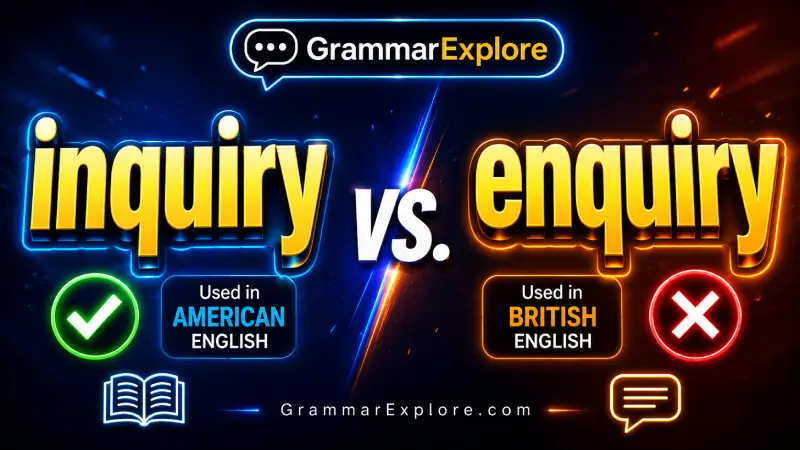
Inquiry vs enquiry is mainly a regional spelling choice. Both nouns can mean a question, a request for information, or an investigation. However, inquiry is the standard and strongly preferred spelling in American English.
For example:
I sent an inquiry about the available position.
The committee opened an inquiry into the complaint.
British English uses both forms, although enquiry appears more often there than it does in the United States. Some British writers prefer enquiry for an ordinary request and inquiry for a formal investigation. However, major dictionaries show considerable overlap, so this is not a universal rule.
Therefore, if you write for a US audience, use inquiry for both general questions and formal investigations. Its plural is inquiries.
Quick Answer
Both spellings are correct, and their meanings overlap. However:
- Inquiry is the preferred American spelling.
- Enquiry is chiefly associated with British English.
- In US writing, inquiry can mean either a request for information or an investigation.
- The plurals are inquiries and enquiries.
- The related verbs are inquire and enquire.
For American English, choose inquiry.
Which Is Correct, Enquiry or Inquiry?
Both enquiry and inquiry are correct, but their usage depends on the variety of English. Inquiry is the preferred spelling in American English for all meanings. In British English, enquiry is commonly used for general questions, while inquiry often refers to a formal investigation.
Should I Use Inquire or Enquire?
Both verbs are correct. Inquire is the standard choice in American English, while enquire is more common in British English for general questions. In formal British contexts involving official investigations, inquire may also be used.
Is It Enquiry or Inquiry in New Zealand?
In New Zealand, enquiry is commonly used for general questions, following British English conventions. Inquiry is usually reserved for formal investigations or official proceedings, although both spellings are understood.
Why People Confuse Them
The words differ by only one initial vowel:
- inquiry
- enquiry
In addition, they generally sound the same. Therefore, pronunciation does not help writers decide which spelling fits.
Regional differences create most of the uncertainty. American websites, businesses, schools, and government publications usually use inquiry. Meanwhile, British content may contain either inquiry or enquiry.
For example, an American business might write:
Submit a customer inquiry through our website.
A British business might write:
Submit a customer enquiry through our website.
The meaning remains the same.
Some usage advice also presents a neat distinction:
- enquiry = an ordinary question
- inquiry = a formal investigation
This distinction can be useful in certain British contexts. However, actual usage does not follow it consistently. Cambridge, for example, defines inquiry as both a question and an official fact-finding process while presenting enquiry as a British form. Cambridge Dictionary
Consequently, American writers do not need to maintain that proposed difference.
Key Differences At A Glance
| Context | Best Choice | Why |
|---|---|---|
| General American English | Inquiry | Standard US preference |
| Request for information in the US | Inquiry | Natural American usage |
| Formal investigation in the US | Inquiry | Standard for official reviews |
| Academic research | Inquiry | Common in scholarly expressions |
| Customer service in the US | Inquiry | Expected spelling |
| General British English | Inquiry or enquiry | Both forms occur |
| British request for information | Often enquiry | Common British preference |
| Official name or quotation | Preserve the original spelling | Do not alter an official title |
A compact comparison makes the choice clear:
- Meaning: Usually the same
- Inquiry: Preferred in American English
- Enquiry: More common in British English
- Plural forms: Inquiries and enquiries
- Pronunciation: Generally the same
- Best US choice: Inquiry
Meaning And Usage Difference
A Question Or Request For Information
An inquiry can be a question or request made to obtain information.
For example:
- I submitted an inquiry about tuition costs.
- The hotel received an inquiry about room availability.
- Please direct your inquiry to the customer service team.
- The company responded to my inquiry the next morning.
In American English, inquiry works naturally in all these sentences.
British writers may use enquiry instead:
- I submitted an enquiry about tuition costs.
- The hotel received an enquiry about room availability.
Again, the spelling changes, but the basic meaning does not.
An Investigation
An inquiry can also be a careful, systematic, or official investigation.
For example:
- The board launched an inquiry into the missing funds.
- Officials ordered an inquiry into the accident.
- The committee’s inquiry lasted several months.
- A public inquiry examined the project’s environmental impact.
Merriam-Webster defines inquiry as a request for information, a systematic investigation, or an examination into facts and principles. Merriam-Webster
Therefore, the American spelling covers both ordinary questions and formal investigations.
Research And Learning
Inquiry can describe a process of asking questions, investigating evidence, or seeking knowledge.
For example:
- Scientific inquiry requires careful observation.
- The course encourages independent inquiry.
- Students learn through discussion and inquiry.
- Her main area of inquiry is language development.
In education, inquiry-based learning describes an approach in which students explore questions, problems, or evidence rather than only receiving information directly.
For a US audience, write:
inquiry-based learning
A British publication may use:
enquiry-based learning
Does Enquiry Have A Different Meaning?
Usually, no. Enquiry can express the same meanings as inquiry.
Cambridge identifies enquiry as a UK form corresponding to inquiry, while Merriam-Webster describes it as a chiefly British spelling. Cambridge Dictionary, Merriam-Webster
Some British writers use enquiry for a general question and reserve inquiry for a formal investigation:
- customer enquiry
- government inquiry
However, this distinction represents a style preference rather than a universal grammatical rule. British dictionaries and publications may use either spelling for both meanings.
Therefore, do not claim that one spelling can only mean “question” and the other can only mean “investigation.”
Plural Forms
Both nouns change the final y to ies in the plural:
- inquiry → inquiries
- enquiry → enquiries
For example:
The office received several inquiries.
The British company answered customer enquiries.
Do not write:
- inquirys
- enquirys
- inquiry’s when you mean more than one inquiry
Pronunciation
Inquiry and enquiry generally share the same pronunciations. In American speech, you may hear versions close to:
- “in-KWY-ree”
- “IN-kwuh-ree”
Regional and individual pronunciation varies. However, the initial spelling does not normally produce a reliable pronunciation difference.
Tone, Context, And Formality
Both inquiry and enquiry can sound more formal than the everyday word question.
Compare:
I have a question about my order.
I have an inquiry about my order.
Both sentences work. However, the second sounds more formal or businesslike.
Inquiry appears naturally in:
- Customer service
- Government reports
- Academic writing
- Legal discussions
- Scientific research
- Business communication
- Education
- Journalism
For example:
Please send all media inquiries to the communications office.
Enquiry can appear in similar British contexts. However, it may look unusual or inconsistent in an otherwise American article.
Therefore, US writers should choose inquiry unless they are quoting a British source or preserving an official title.
Which One Should You Use?
Use inquiry when writing for an American audience.
This recommendation applies whether you mean:
- A question
- A request for information
- A formal investigation
- Academic examination
- Scientific research
- A line of questioning
For example:
The customer submitted an inquiry.
The agency began an inquiry.
Researchers developed a new line of inquiry.
Use enquiry when following a British house style that prefers it, particularly for requests for information.
For example:
Please send your enquiry by email.
You should also preserve enquiry when it appears in:
- An official organization name
- A quoted title
- A direct quotation
- A British publication’s established terminology
Most importantly, choose one regional convention and use it consistently.
When One Choice Sounds Wrong
Consider this sentence on an American business website:
For sales enquiries, contact our support team.
The meaning is clear. However, the expected American version is:
For sales inquiries, contact our support team.
Similarly:
The US Senate opened an enquiry into the matter.
Although enquiry can mean an investigation, American readers will expect:
The US Senate opened an inquiry into the matter.
Now consider a direct quotation from a British organization. If its official page uses Public Enquiry Office, changing the title to Public Inquiry Office could misrepresent the original wording.
Therefore, regional consistency matters, but accuracy also requires preserving official spellings.
Inquiry vs Inquire
Inquiry is a noun:
I sent an inquiry.
Inquire is a verb:
I called to inquire about the price.
The British forms follow the same pattern:
- enquiry = noun
- enquire = verb
For American English, use:
- inquiry
- inquire
- inquirer
For British English, you may encounter:
- enquiry
- enquire
- enquirer
Inquiry vs Query
A query is usually a question, especially a specific question submitted to obtain information.
The editor answered my query.
An inquiry can mean a question, but it can also describe a broader investigation:
The board opened an inquiry.
Therefore, query and inquiry overlap, but they are not interchangeable in every sentence.
Common Mistakes (And Quick Fixes)
Mistake: Using enquiry throughout a US-focused article.
Fix: Use inquiry for American English.
Mistake: The company received several inquirys.
Fix: The company received several inquiries.
Mistake: We submitted three inquiry’s.
Fix: We submitted three inquiries.
Mistake: Assuming enquiry is always incorrect.
Fix: Recognize it as an established form used especially in British English.
Mistake: Claiming that enquiry can only mean a question.
Fix: Remember that its meanings overlap with those of inquiry.
Mistake: Claiming that inquiry can only mean an investigation.
Fix: It can also mean a question or request for information.
Mistake: Switching between inquiry and enquiry in one article.
Fix: Follow one regional spelling system consistently.
Mistake: Using inquiry as a verb.
Fix: Use inquire as the verb.
Everyday Examples
Inquiry As A Request For Information
I sent an inquiry about the apartment.
The company responded to my inquiry.
We received an inquiry from a potential customer.
Please direct your inquiry to the front desk.
Her email included an inquiry about pricing.
The office handles hundreds of inquiries each week.
I made an inquiry about the application deadline.
They answered every customer inquiry promptly.
Inquiry As An Investigation
The board opened an inquiry into the complaint.
Officials launched an inquiry after the accident.
The inquiry found several procedural problems.
A formal inquiry will examine the decision.
The committee completed its inquiry last month.
Investigators followed a new line of inquiry.
The public inquiry included testimony from residents.
The report summarized the results of the inquiry.
Inquiry In Academic And Scientific Contexts
- Scientific inquiry begins with careful questions.
- The class encourages independent inquiry.
- Her research opened a new area of inquiry.
- Students used an inquiry-based approach.
- The study supports further inquiry.
- Open inquiry can lead to unexpected discoveries.
Examples With Enquiry
These examples follow a common British spelling:
- Please submit your enquiry online.
- The office received several enquiries.
- I made an enquiry about train times.
- The hospital opened an enquiry into the incident.
- A customer service representative answered my enquiry.
For US writing, replace enquiry with inquiry in each sentence.
Dictionary-Style Word Details
Verb
Inquiry: Not a verb. It is a noun. The related American verb is inquire.
Call the office to inquire about availability.
Enquiry: Also a noun rather than a verb. The corresponding form is enquire, which appears especially in British English.
She called to enquire about the schedule.
For American writing, prefer inquire.
Noun
Inquiry: A request for information, a question, an investigation, or a process of seeking knowledge.
The agency opened an inquiry.
Enquiry: A regional spelling variant with the same core meanings, used mainly in British English.
The customer submitted an enquiry.
Both are countable in many contexts:
- one inquiry → two inquiries
- one enquiry → two enquiries
They can also appear more broadly without an article:
Scientific inquiry requires evidence.
Synonyms
For an inquiry meaning a question:
question
query
request
request for information
For an inquiry meaning an investigation:
- investigation
- examination
- review
- probe
- study
- fact-finding process
For academic or scientific inquiry:
- research
- exploration
- examination
- investigation
These alternatives are not exact matches in every context.
For example:
The committee opened an inquiry.
Here, investigation works well. However, question does not.
Possible contextual opposites include:
- answer
- response
- conclusion
Still, no single antonym fits every meaning.
Example Sentences
Inquiry:
- I submitted an inquiry about the position.
- The committee began an inquiry.
- We received several media inquiries.
- The researchers developed a new line of inquiry.
- The company answered my inquiry quickly.
Enquiry:
- She made an enquiry about ticket prices.
- The office handles customer enquiries.
- A formal enquiry examined the accident.
- Please send your enquiry by email.
- The receptionist answered my enquiry.
Word History
Inquiry and enquiry belong to the same word family and share the same central idea: seeking information, asking questions, or examining facts.
Both spellings developed in English. Over time, regional preferences became clearer. American English strongly favored inquiry, while British English continued using both forms.
Some British usage traditions later encouraged a distinction between ordinary enquiries and formal inquiries. However, dictionaries and real-world usage do not apply that distinction consistently.
Therefore, present-day audience and house style provide a more reliable guide than a rigid meaning rule.
Phrases Containing
Common American expressions include:
- make an inquiry
- submit an inquiry
- customer inquiry
- sales inquiry
- media inquiry
- general inquiry
- formal inquiry
- public inquiry
- congressional inquiry
- line of inquiry
- area of inquiry
- scientific inquiry
- inquiry-based learning
- inquiry form
- further inquiry
- respond to inquiries
British versions may include:
- make an enquiry
- customer enquiry
- general enquiry
- enquiry form
- enquiry desk
- further enquiries
- line of enquiry
For a US audience, choose the forms with inquiry.
Frequently Asked Questions
Is inquiry or enquiry correct?
Both spellings are correct. However, inquiry is standard in American English, while enquiry appears more often in British English.
Which spelling should Americans use?
Americans should use inquiry for questions, requests for information, investigations, and academic research.
Do inquiry and enquiry mean the same thing?
Yes, their meanings generally overlap. Both can refer to a question, request, investigation, or process of seeking information.
Is enquiry a misspelling in the US?
It is not an invented spelling, but it is uncommon in American English. Therefore, US-focused writing should normally use inquiry.
What is the plural of inquiry?
The plural is inquiries:
We received several inquiries.
What is the plural of enquiry?
The plural is enquiries:
The office received several enquiries.
Is it inquiry form or enquiry form?
Use inquiry form in American English. British organizations may use enquiry form.
Conclusion
The inquiry vs enquiry choice depends mainly on regional convention rather than a strict difference in meaning.
Both words can refer to a question, request for information, investigation, or search for knowledge. However, inquiry is the standard choice in American English for every one of these meanings.
British English uses both forms. Although some British writers distinguish an ordinary enquiry from a formal inquiry, that division is not universal.
Remember:
American English → inquiry and inquiries
British English → inquiry/enquiry and inquiries/enquiries
Related US verb → inquire
For clear and consistent US writing, choose inquiry.