
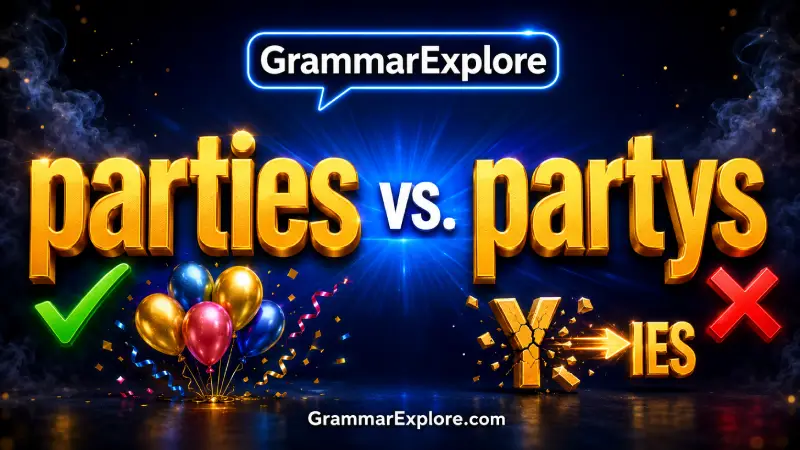
The correct plural of party is parties, not partys. When a noun ends in a consonant followed by y, English usually changes the y to i and adds -es.
This rule applies whether party means a social gathering, a political organization, a group involved in an agreement, or one side in a legal case.
- One birthday party becomes two birthday parties.
- One political party becomes several political parties.
- One party to a contract becomes both parties to a contract.
The spelling partys is not standard English. However, writers also confuse parties with the possessive forms party’s and parties’. Understanding plural and possessive forms will help you choose the correct spelling every time.
Quick Answer
Use parties when you mean more than one party:
- We attended three parties this month.
- Both parties signed the agreement.
Do not use partys as the plural:
- Incorrect: We attended three partys.
- Correct: We attended three parties.
Use party’s for something belonging to one party and parties’ for something belonging to multiple parties.
What Is the Correct Plural of Party?
The correct plural of party is parties. When a noun ends in a consonant followed by -y, change the y to -ies to form the plural.
Examples:
- We attended several parties this summer.
- Both parties agreed to the contract.
When to Use Parties vs. Party?
Use party when referring to one person, group, celebration, or organization. Use parties when referring to two or more.
Examples:
- The party starts at 7 p.m.
- Several parties attended the meeting.
How Do You Spell Two Parties?
The correct spelling is parties. It is the plural form of party and is used when referring to more than one.
Examples:
- The two parties signed the agreement.
- We planned two birthday parties.
Is “Parties” a Word?
Yes. Parties is a standard English word and the correct plural of party. It can refer to celebrations, political groups, legal parties, or people involved in an agreement.
Examples:
- The parties reached a settlement.
- We were invited to three parties this month.
Why People Confuse Them
Many English nouns form their plurals by adding -s:
- car becomes cars
- book becomes books
- table becomes tables
Following that familiar pattern, a writer may add -s directly to party and produce partys. However, nouns ending in a consonant plus y follow a different spelling rule.
In party, the letter t comes before the final y. Because t is a consonant, change the y to i and add -es:
party → parties
Apostrophes create additional confusion because these forms look similar:
- parties
- party’s
- parties’
Each form has a different grammatical job.
Key Differences At A Glance
| Feature | Parties | Partys |
|---|---|---|
| Standard English Form | Yes | No |
| Main Use | Plural of party | Usually a spelling error |
| Meaning | More than one party | No separate standard meaning |
| Apostrophe Needed | No | No |
| Example | We planned two parties | Avoid this spelling |
A compact comparison of the related forms:
- party: one gathering, group, or participant
- parties: more than one party
- party’s: belonging to one party
- parties’: belonging to multiple parties
- partys: incorrect spelling
Meaning And Usage Difference
What Does Parties Mean?
Parties is the plural form of the noun party. It can describe more than one social event:
- We received invitations to two graduation parties.
- The hotel hosts private parties on weekends.
It can also refer to political organizations:
- Several political parties nominated candidates.
- The two parties disagree on the proposed law.
In legal and business writing, parties can mean the people or organizations involved in an agreement, dispute, or transaction:
- Both parties accepted the contract terms.
- The parties reached a settlement.
- All interested parties received a copy of the report.
The word can also function as the third-person singular form of the verb party:
- He parties with his friends on weekends.
- She rarely parties during the school year.
In this verb use, parties describes someone attending or enjoying social gatherings.
What Does Partys Mean?
Partys is not a standard English word. It usually appears when someone adds -s to party without changing the final y.
- Incorrect: The restaurant hosts holiday partys.
- Correct: The restaurant hosts holiday parties.
Partys does not represent a special type of party, a regional spelling, or an accepted alternative plural.
The Plural Rule For Words Ending In Y
When a singular noun ends in a consonant plus y, change the y to i and add -es:
| Singular | Plural |
|---|---|
| party | parties |
| baby | babies |
| city | cities |
| country | countries |
| story | stories |
| family | families |
The same pattern gives us:
- birthday party → birthday parties
- political party → political parties
- third party → third parties
However, if a vowel comes before the final y, keep the y and add -s:
- day → days
- key → keys
- boy → boys
- toy → toys
- valley → valleys
Compare the patterns:
- party has consonant + y, so it becomes parties
- play has vowel + y, so it becomes plays
Tone, Context, And Formality
Parties works in formal and informal English. Its meaning depends on the surrounding context.
Informal social context:
- We went to several parties during summer break.
Professional context:
- The company plans holiday parties for its employees.
Political context:
- Both parties announced their candidates.
Legal context:
- The parties must follow the terms of the agreement.
The spelling rule does not change with tone or subject. Always use parties when you need the plural or the third-person singular verb.
Because partys is incorrect, it can make school, legal, political, or professional writing look careless.
Which One Should You Use?
| Context | Best Choice | Why |
|---|---|---|
| More than one celebration | Parties | It is the correct plural |
| Multiple political organizations | Parties | It is the plural of political party |
| People or groups in a contract | Parties | It is standard legal usage |
| He or she attends celebrations | Parties | It is the third-person singular verb |
| Something belongs to one party | Party’s | The apostrophe shows singular possession |
| Something belongs to several parties | Parties’ | The apostrophe shows plural possession |
| Any plural written as “partys” | Parties | “Partys” is nonstandard |
Ask two questions before choosing a form:
- Do I mean more than one party? Use parties.
- Am I showing ownership? Use party’s or parties’, depending on the number of owners.
Parties, Party’s, And Parties’
These three forms are correct, but they serve different purposes.
Parties: More Than One
Use parties without an apostrophe when you mean multiple gatherings, groups, or participants:
- We attended two parties.
- Both parties approved the contract.
- Several parties competed in the election.
Party’s: Belonging To One Party
Use party’s when something belongs to one party:
- The party’s theme was outer space.
- The political party’s candidate gave a speech.
- One party’s attorney requested more time.
In each sentence, the apostrophe plus s shows singular possession.
Party’s can also mean party is or party has in informal contractions:
- The party’s starting at eight.
Meaning: The party is starting at eight. - The party’s been postponed.
Meaning: The party has been postponed.
Parties’: Belonging To Multiple Parties
Use parties’ when something belongs or relates to more than one party:
- The parties’ attorneys met before the hearing.
- We compared the political parties’ proposals.
- The parties’ responsibilities appear in the contract.
First form the plural parties, and then add an apostrophe after the final s.
When One Choice Sounds Wrong
Using partys for the plural creates a spelling error:
- Incorrect: Three partys will appear on the ballot.
- Correct: Three parties will appear on the ballot.
- Incorrect: The hotel hosted several partys.
- Correct: The hotel hosted several parties.
An apostrophe does not form a regular plural:
- Incorrect: We attended two party’s.
- Correct: We attended two parties.
The form party’s shows possession or represents a contraction. It does not mean more than one party.
Placing an apostrophe after parties also changes the meaning:
- The parties ended at midnight.
This sentence refers to multiple social events. - The parties’ schedules changed.
This sentence refers to schedules associated with multiple parties.
Common Mistakes And Quick Fixes
Mistake: Adding S Directly To Party
- Incorrect: We planned two partys.
- Correct: We planned two parties.
Change the y to i and add -es.
Mistake: Using An Apostrophe For A Plural
- Incorrect: The park hosted several party’s.
- Correct: The park hosted several parties.
A simple plural does not need an apostrophe.
Mistake: Confusing Singular And Plural Possession
- One party: The party’s decorations looked beautiful.
- Multiple parties: The parties’ decorations filled both rooms.
The apostrophe comes before s for one party and after s for multiple parties.
Mistake: Using Parties For One Event
- Incorrect: Her birthday parties starts at noon.
- Correct: Her birthday party starts at noon.
Use party when referring to one gathering.
Mistake: Forgetting Subject-Verb Agreement
- Incorrect: The parties was canceled.
- Correct: The parties were canceled.
Because parties is plural in this sentence, it takes the plural verb were.
Mistake: Misreading The Verb Form
In this sentence, parties is a verb:
- Marcus parties every weekend.
It does not mean multiple parties. It describes what Marcus does.
Everyday Examples
Social Events
- We attended three birthday parties in June.
- Both parties ended before midnight.
- The restaurant hosts private parties upstairs.
- Children’s parties often include games and snacks.
- Our neighbors invited us to their holiday parties.
- She plans parties for corporate clients.
- He parties with his college friends on weekends.
Political Groups
- Several political parties participated in the debate.
- The two major parties announced their platforms.
- Smaller parties may influence close elections.
- Both parties supported the local proposal.
- The parties’ representatives met on Tuesday.
Legal And Business Contexts
- Both parties signed the agreement.
- The parties reached a settlement before trial.
- All parties must receive written notice.
- The contract explains each party’s responsibilities.
- The parties’ attorneys reviewed the new evidence.
- Interested parties may submit comments online.
Direct Comparisons
- Incorrect: The city held two block partys.
- Correct: The city held two block parties.
- Incorrect: Both partys accepted the offer.
- Correct: Both parties accepted the offer.
- Incorrect: The party’s lasted all night.
- Correct: The parties lasted all night.
Dictionary-Style Word Details
Verb
- Parties: The third-person singular form of party, meaning to attend or enjoy a lively social gathering.
- Partys: Not a standard verb form.
Examples:
- She parties with friends after final exams.
- He rarely parties during the week.
Other verb forms include:
- party
- parties
- partied
- partying
Notice that the past tense also changes the y:
party → partied
The -ing form keeps the y:
party → partying
Noun
- Parties: The plural of party. It may refer to social events, political organizations, groups, individuals in agreements, or sides in legal disputes.
- Partys: Not a standard noun form.
Examples:
- The parties attracted hundreds of guests.
- Both parties agreed to mediation.
Synonyms
For parties meaning social gatherings, the closest alternatives include:
- celebrations
- gatherings
- receptions
- events
- festivities
For parties in a legal or business context, possible alternatives include:
- participants
- sides
- signers
- individuals
- organizations
These words are not exact replacements in every sentence.
Partys has no synonyms because it is not a standard form.
No single antonym fits every meaning of parties.
Example Sentences
Parties:
- The school organized graduation parties for the students.
- Both parties presented their arguments.
- She parties only on special occasions.
- Several parties expressed interest in the property.
- The political parties held separate meetings.
Partys:
- “Partys” is an incorrect spelling of “parties.”
- An editor would replace “partys” with “parties.”
Word History
Party entered English through French and originally related to a part, side, or group. Its meanings expanded over time to include political organizations, people involved in agreements, and social gatherings.
The plural parties follows the standard English pattern for words ending in a consonant plus y. The form partys results from applying the simple “add -s” rule where it does not belong.
Phrases Containing
Common phrases with parties include:
- birthday parties
- holiday parties
- political parties
- opposition parties
- interested parties
- third parties
- both parties
- all parties
- parties involved
- parties to the agreement
- parties to a lawsuit
- private parties
Standard phrases do not use partys.
Frequently Asked Questions
Is parties or partys correct?
Parties is correct. Partys is not a standard spelling. Change the final y in party to i and add -es.
What is the plural of party?
The plural of party is parties:
- one party
- two parties
This rule applies to social, political, business, and legal meanings.
Why does party become parties?
The word party ends in a consonant followed by y. For most nouns with this ending, change the y to i and add -es.
What is the difference between parties and party’s?
Parties means more than one party. Party’s shows that something belongs to one party or contracts party is or party has.
What does parties’ mean?
Parties’ is the plural possessive form. It describes something connected with or belonging to multiple parties:
- The parties’ lawyers reached an agreement.
Can parties be a verb?
Yes. Parties can mean attends or enjoys social gatherings:
- She parties with her coworkers after major projects.
Conclusion
Use parties, not partys, as the plural of party. The spelling follows a common rule: when a consonant comes before a final y, change the y to i and add -es.
Remember the four forms:
- party = one
- parties = more than one
- party’s = belonging to one
- parties’ = belonging to more than one
Whether you are discussing celebrations, elections, contracts, or court cases, parties is the correct plural spelling.